
CPAP or oral appliance: how do you choose a sleep apnea treatment?
Treating sleep apnea means choosing an effective solution that you can also use night after night. CPAP and the mandibular advancement device meet this goal through different mechanisms. Discreet, mask-free and easy to travel with, a custom oral appliance is a treatment option in its own right for patients for whom it is indicated.
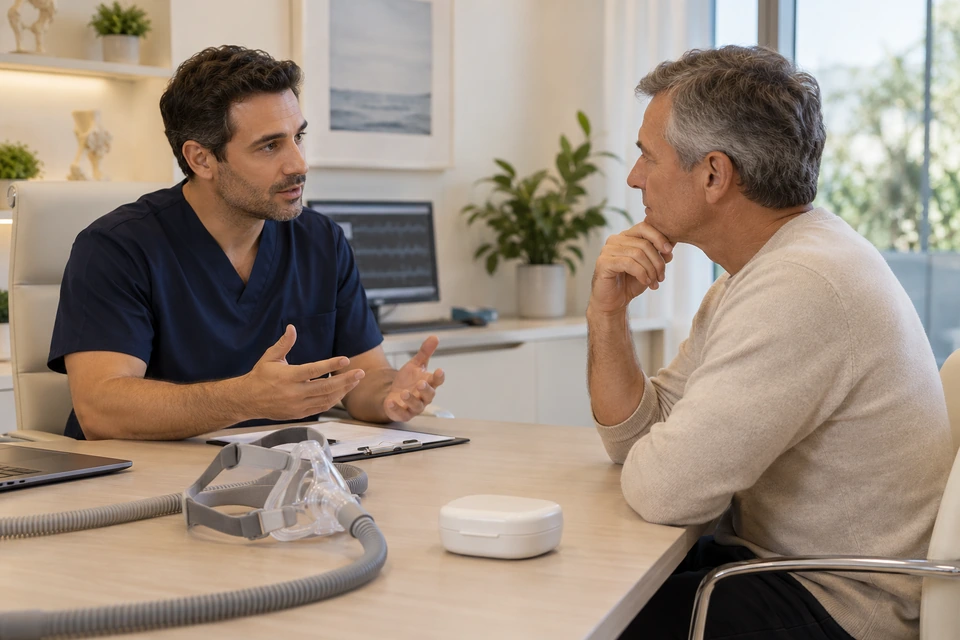
What are the everyday advantages of an oral appliance?
The appliance is worn in the mouth during sleep and holds the lower jaw forward to help keep the airway open. Its practical advantages can make a real difference:
- No mask or tubing: no pressurised air blown onto the face.
- No motor or power supply at night: a compact device that is easy to carry, especially when travelling.
- Custom-made and adjustable: fitting to your teeth and gradual adjustments help find a balance between effectiveness and comfort.
Adaptation remains individual. Tooth or jaw discomfort may occur, and changes in how the teeth meet are possible in the long term: dental follow-up is part of treatment. 1 6
CPAP and oral appliances: what are the differences?
CPAP — continuous positive airway pressure — keeps the airway open with pressurised air delivered through a mask.
| Comparison | CPAP | Mandibular advancement device |
|---|---|---|
| Equipment | Device connected to a mask | Custom intraoral appliance |
| Average effect on breathing | Generally greater reduction of apneas and hypopneas | Variable reduction depending on individual response |
| Adaptation | Mask, settings, nasal breathing and comfort | Dental assessment, fitting and gradual adjustments |
| Checking the result | Treatment data and tests depending on the situation | Sleep test with the appliance and medical and dental follow-up |
A better result on a recording and regular use are two complementary dimensions. This is why studies also look at symptoms, quality of life and certain health measures. 3
What do recent studies show about oral appliances versus CPAP?
Sometimes more regular use: CHOICE, 2025
In this Canadian trial, 73 participants entered the comparative phase. Average objectively measured use over one month was 6 hours per night with the appliance, versus 5.3 hours with CPAP. The authors report comparable benefits on patient-centred outcomes, despite better control of breathing events with CPAP. 3
Solid results on blood pressure: CRESCENT, 2024
In 220 patients with moderate to severe sleep apnea, hypertension and increased cardiovascular risk, the appliance was non-inferior to CPAP in reducing mean 24-hour blood pressure after six months. This result applies to this outcome and this population. 4
A review of trials published in 2026
A meta-analysis found no statistically significant difference between oral appliances and CPAP for most of the ambulatory blood pressure measures studied, with a small advantage for the appliance in daytime systolic pressure. It also found no significant difference in the improvement of perceived sleepiness. 5
Key point: an oral appliance can combine practical advantages, real clinical benefit and favourable use. These results do not, however, prove overall equivalence with CPAP, nor identical prevention of heart attacks or strokes.
When can an oral appliance be chosen?
In mild to moderate sleep apnea, it can be discussed according to the medical assessment, your dental situation, your preferences and the constraints of each option.
CPAP generally remains the preferred treatment for severe sleep apnea. For Panthera devices, the instructions for use also provide for second-line use after refusal, failure or intolerance of CPAP, in line with applicable national recommendations. Medical selection and checking the result are then particularly important. 2 6
If you find your CPAP hard to tolerate, the doctor first looks for what is causing the problem and discusses relevant adjustments or alternatives. Do not change a prescribed treatment on your own.
At Shalvina: an oral appliance chosen and supported as part of comprehensive care
We have chosen custom Panthera Classic and X3 appliances, selected for each patient, with digital impressions and personalised adjustments. Dr Chira Riahi-Boukhris provides the dental assessment, fitting and follow-up appointments in Netanya. The result is then assessed with a sleep test with the appliance in place, arranged through your usual care pathway, and by reviewing its results.
Nasal breathing, weight and sleep position are also taken into account when they play a role in your sleep apnea. Treatment is therefore not just about choosing a device. 1 2
Has your doctor already recommended an oral appliance?
About Panthera oral appliance therapy and assessment in Netanya
Would you like to reassess your treatment or discuss your options?
Dr Marc Boukhris offers a complete ENT examination, a personal explanation, a written report and a plan for the next steps.
Scientific references
-
Levine M, Cantwell M, Postol K, Schwartz D. Dental Sleep Medicine Standards for Screening, Treatment, and Management of Sleep-Related Breathing Disorders in Adults Using Oral Appliance Therapy: An Update. Journal of Dental Sleep Medicine. 2025;12(2). doi:10.15331/jdsm.7384. AADSM professional standards.
-
Department of Veterans Affairs / Department of Defense. Clinical Practice Guideline for the Management of Chronic Insomnia Disorder and Obstructive Sleep Apnea. Version 3.0, 2025. Full professional guideline.
-
Hamoda MM, Huynh N, Ayas NT, et al. Continuous positive airway pressure and mandibular advancement splints: the CHOICE multicentre, open-label randomised clinical trial. European Respiratory Journal. 2025;65(4):2401100. doi:10.1183/13993003.01100-2024. CHOICE randomised trial.
-
Ou YH, Colpani JT, Cheong CS, et al. Mandibular Advancement vs CPAP for Blood Pressure Reduction in Patients With Obstructive Sleep Apnea. Journal of the American College of Cardiology. 2024;83(18):1760–1772. doi:10.1016/j.jacc.2024.03.359. CRESCENT randomised trial.
-
Cheng T, Wang Q, Wei W. Effects of mandibular advancement devices vs. CPAP on blood pressure in obstructive sleep apnea: a systematic review and meta-analysis of randomized controlled trials. Frontiers in Neurology. 2026;17:1846726. doi:10.3389/fneur.2026.1846726. Meta-analysis of randomised trials.
-
Ramar K, Dort LC, Katz SG, et al. Clinical Practice Guideline for the Treatment of Obstructive Sleep Apnea and Snoring with Oral Appliance Therapy: An Update for 2015. Joint AASM/AADSM clinical guideline. Journal of Dental Sleep Medicine. 2015;2(3):71–125. doi:10.15331/jdsm.4868. Official AASM/AADSM text. Founding guideline, complemented here by recent standards and publications.